A boxing equipment manufacturer can influence far more than your product cost. The factory you select affects product safety, brand reputation, delivery schedules, customer satisfaction, and your ability to place repeat orders.
A polished sample is not enough. You need a manufacturer that can reproduce the approved quality consistently across a complete bulk order.
This guide explains how brands, wholesalers, distributors, retailers, and commercial gyms can evaluate a custom boxing equipment supplier before committing to production.
1. Choose a Manufacturer with Boxing Equipment Experience
Start by confirming that the supplier regularly manufactures boxing and combat-sports products.
A general sporting-goods factory may not understand the construction requirements of boxing gloves, head guards, focus pads, punching bags, hand wraps, and protective equipment.
Ask the manufacturer:
- Which boxing products do you manufacture in-house?
- Which production processes are subcontracted?
- Which materials and padding systems do you offer?
- Can you produce coordinated product collections?
- Do you work with private-label and wholesale buyers?
A specialist manufacturer should be able to discuss materials, padding, stitching, sizing, closures, branding, packaging, and product testing in practical detail.
2. Request Samples Before Bulk Production
Samples allow you to evaluate the factory’s workmanship before placing a larger order.
For custom products, the manufacturer should develop a sample using your selected materials, colors, logo, dimensions, padding, labels, and packaging requirements.
When inspecting a sample, check:
- Overall shape and symmetry
- Stitching consistency
- Padding placement
- Wrist support and closure strength
- Lining comfort
- Printed or embroidered logo quality
- Edge finishing
- Product weight and dimensions
- Packaging presentation
Do not approve a sample based only on photographs. Inspect the physical product whenever possible.
The final approved sample should become the reference standard for bulk production.
3. Confirm Materials and Construction Specifications
Two products can look similar in photographs while using very different materials and construction methods.
Ask for a written specification sheet covering:
- Outer-shell material
- Material thickness or grade
- Padding type and density
- Inner lining
- Thread and stitching requirements
- Closure system
- Product dimensions
- Weight tolerance
- Logo application
- Labels and packaging
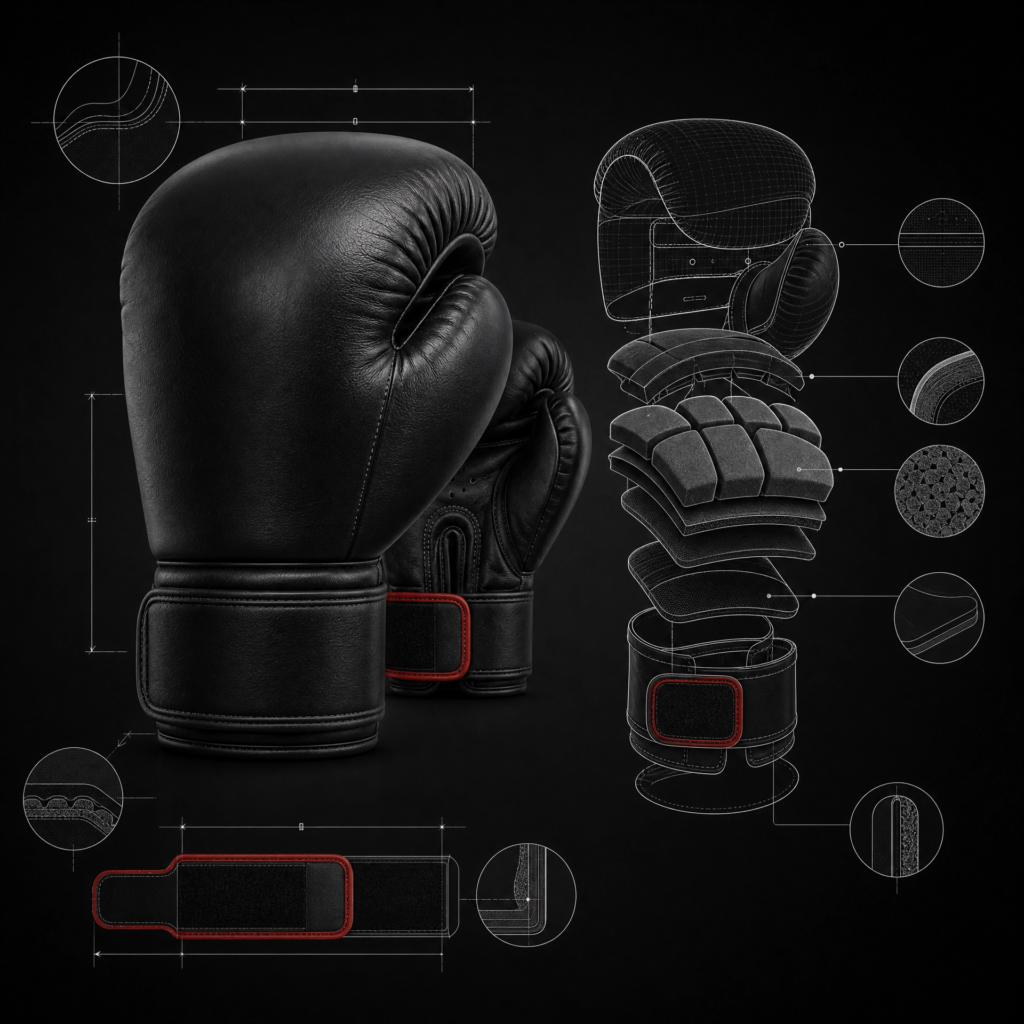
For example, the price and performance of custom boxing gloves can change considerably depending on the shell material, foam construction, lining, wrist support, and branding method.
Written specifications reduce misunderstandings and make quotations easier to compare.
4. Evaluate Customization Capabilities
A private-label manufacturer should do more than place a logo on an existing product.
Depending on the product, customization may include:
- Materials
- Colors
- Padding
- Product shape
- Sizes and weights
- Velcro or lace-up closures
- Screen-printed logos
- Embroidered logos
- Woven labels
- Size and care labels
- Hangtags
- Poly bags
- Retail boxes
- Shipping cartons
Ask which elements can be customized and whether certain options require a higher minimum order quantity.
You should also confirm how many revisions are included during sample development and how design changes affect cost and production time.
5. Understand the Quality-Control Process
Reliable production requires quality checks throughout manufacturing, not only after the order is finished.
Ask the factory how it controls quality during:
Incoming material inspection
Materials should be checked before cutting or assembly begins.
In-process inspection
Stitching, padding placement, logos, dimensions, and construction should be reviewed while products are being manufactured.
Final inspection
Finished products should be checked against the approved sample and specification sheet.
Packaging inspection
Labels, quantities, barcodes, retail packaging, and shipping cartons should match the purchase order.
A reliable boxing equipment factory should be able to explain its inspection process clearly. Buyers may also arrange an independent factory audit or pre-shipment inspection when appropriate.
6. Compare MOQ and Pricing Carefully
The lowest quotation is not always the lowest-cost option.
Before comparing prices, confirm that each manufacturer is quoting the same materials, construction, branding, packaging, and inspection requirements.
Ask whether the minimum order quantity applies:
- Per product
- Per design
- Per color
- Per size
- Per logo
- Across the complete order
You should also request details about sample charges, tooling costs, packaging costs, payment terms, freight, and any additional development fees.
A transparent manufacturer will explain what is included in the quotation instead of providing only a single unit price.
7. Confirm Production Capacity and Lead Times
Ask for separate timelines for:
- Design confirmation
- Sample development
- Sample revisions
- Bulk production
- Final inspection
- Packaging
- Shipping
Production should begin only after the sample, specifications, quotation, and purchase order have been approved.
Be cautious when a factory promises an unusually fast lead time without reviewing your product requirements. Realistic planning is more valuable than an attractive deadline that cannot be met.
Allow additional time for sample revisions, peak production periods, custom materials, packaging development, inspections, and international shipping.
8. Assess Communication Before Placing an Order
Communication during the enquiry stage often indicates how the supplier will manage production.
A reliable manufacturer should:
- Answer technical questions clearly
- Confirm specifications in writing
- Identify missing information
- Explain limitations honestly
- Provide organized quotations
- Communicate changes promptly
- Assign a clear contact person
Avoid relying only on informal chat messages. Important specifications, approvals, prices, and delivery commitments should be recorded in documents or email.
9. Check the Manufacturer’s Credibility
Before sending a large deposit, perform reasonable supplier checks.
Depending on the order value, these may include:
- Reviewing business and export information
- Requesting a live factory video call
- Inspecting recent production photographs
- Asking for customer references where available
- Verifying certifications with the issuing organization
- Arranging a factory audit
- Using a third-party pre-shipment inspection
- Confirming that payment details match the supplier’s legal information
Product photographs alone do not prove manufacturing capability. Look for evidence that the supplier understands both the product and the production process.
Boxing Equipment Manufacturer Evaluation Checklist
| Area | What to Confirm |
| Experience | Regular production of boxing and combat-sports equipment |
| Samples | Custom sample available before bulk production |
| Specifications | Materials and construction documented in writing |
| Customization | Colors, logos, labels, packaging, and product features |
| Quality control | Material, in-process, final, and packaging inspections |
| MOQ | Clear quantities by product, color, size, and design |
| Pricing | Transparent inclusions and additional costs |
| Lead time | Realistic sample, production, and shipping schedule |
| Communication | Clear technical answers and written confirmation |
| Verification | Factory evidence, references, audits, or inspections |
Warning Signs to Avoid
Consider another supplier when a manufacturer:
- Refuses to provide samples
- Gives vague material descriptions
- Avoids written specifications
- Uses inconsistent company or payment details
- Cannot explain its quality-control process
- Promises unrealistic production times
- Changes prices repeatedly without explanation
- Pressures you to approve production immediately
- Cannot show relevant manufacturing experience
One warning sign may have a reasonable explanation. Several warning signs together indicate unnecessary risk.
Work with The Professional Sports
Since 2008, The Professional Sports has manufactured custom OEM and private-label boxing equipment, MMA gear, protective products, and uniforms for brands, wholesalers, distributors, and commercial gyms.
We can help you review product ideas, materials, padding, branding, samples, order quantities, packaging, and production requirements before bulk manufacturing begins.